
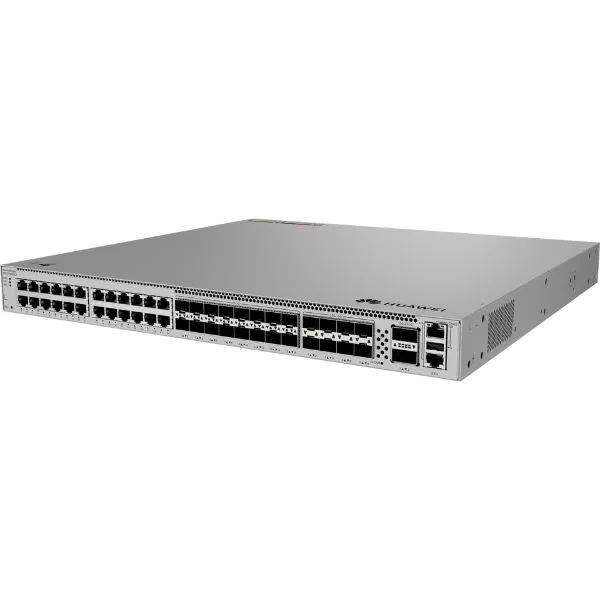
S620-24T16X8Y2CZ - Switch eKit Core Empresarial Capa 3
S620-24T16X8Y2CZ - Switch eKit Core Empresarial Capa 3
S/ 5,857.99
 Preguntar stock
Descripcion
- S620-24T16X8Y2CZ - 24 x 10/100/1000M BASE-T ports, 16 x 10GE SFP+ ports, 8 x 25GE SFP28 ports, 2 x 40GE/100GE QSFP28 Packet forwarding rate: 1167 Mpps Switching capacity: 1568 Gbit/s
- Garantia: 36 meses
- Descripción general del producto: Huawei eKit S620-24T16X8Y2CZ L3-Managed Switch 24 Port Gigabit, 16 SFP+ 10Gbps, 2 Port QSFP28 40GE/100GE, Stacking, Static/Dynamic Routing OSPF,BGP, VLAN, PBR, IGMP, 802.1x Soporte gestionado a través de la nube, independiente
- Especificaciones técnicas
- Switching capacity: 1168 Gbps
- Packet forwarding rate: 867 Mpps
- Downlink port: 24 x 10/100/1000M BASE-T ports16 x FE/GE/2.5GE/10GE SFP+ ports8 x GE/2.5GE/10GE/25GE SFP28 ports2 x 40GE/100GE QSFP28
- Dimensions (H x W x D): 43.6 mm x 442.0 mm x 420.0 mm
- Chassis height: 1 U
- Weight in full configuration(including packaging materials): 6.31kg
- Power module type: 180 W AC power module (subcard not supported)240 W DC power module400 W DC power module600 W AC power module (delivered with the product)
- Typical power consumption: 122W
- Maximum power consumption: 127W
- Noise: 41.2 dBA
- Long-term operating temperature: –5°C to +45°C (23°F to 113°F)
- Storage temperature: –40°C to +70°C (–40°F to +158°F)
- Relative humidity: 5% to 95% (non-condensing)
- Power port surge protection: AC power port: ±6 kV in differential mode, ±6 kV in common modeDC power port: ±2 kV in differential mode, ±4 kV in common mode
- Heat dissipation mode: Air cooling, intelligent fan speed adjustment
- Característica del servicio
- User management: Unified user management802.1X and MAC address authenticationTraffic- and duration-based accountingUser authorization based on user groups, domains, and time ranges
- MAC address entry: Automatic MAC address learning and agingUp to 64K MAC address entriesStatic, dynamic, and blackhole MAC address entriesSource MAC address filteringMAC address learning limiting based on ports and VLANs
- VLAN: 4K VLANsAccess, trunk, and hybrid portsDefault VLANQinQ and enhanced selective QinQVLAN stackingMAC address–based dynamic VLAN allocation
- ARP: ARP snooping
- IP routing: IPv4 dynamic routing protocols such as RIP, OSPF, IS-IS, and BGPIPv6 dynamic routing protocols such as RIPng, OSPFv3, IS-ISv6, and BGP4+
- IPv6 features: ND (Neighbor Discovery)Path MTU (PMTU)IPv6 ping, IPv6 tracert, and IPv6 Telnet
- Multicast: IGMPv1/v2/v3 and IGMPv1/v2/v3 snoopingPIM DM, PIM SM, and PIM SSMFast leave mechanism for usersMulticast traffic controlMulticast querierMulticast protocol packet suppression
- QoS: Traffic classification based on Layer 2 headers, Layer 3 protocols, Layer 4 protocols, and 802.1p priorityActions such as ACL, CAR, re-marking, and schedulingQueue scheduling modes such as PQ, DRR, and PQ+DRRCongestion avoidance mechanisms such as WRED and tail dropTraffic shapingNetwork slicing
- Native-IP IFIT: Direct marking of service packets to obtain real-time statistics about dropped packets and packet loss rateTwo-way latency measurement for packetsStatistical interval modification
- Ring network protection: STP (IEEE 802.1d), RSTP (IEEE 802.1w), and MSTP (IEEE 802.1s)BPDU protection, root protection, and loop preventionG.8032 Ethernet Ring Protection Switching (ERPS)
- Reliability: M-LAGStackingLACP and inter-device aggregationVirtual Router Redundancy Protocol (VRRP) and Bidirectional Forwarding Detection (BFD) for VRRPBFD for BGP, IS-IS, OSPF, and static routingEthernet OAM (IEEE 802.1ag)Smart Link
- System management: Terminal access services such as console port login, Telnet, and SSHNetwork management protocols, such as SNMPv1/v2/v3File upload and download through FTP, TFTP, and SFTPBoot Read-Only Memory (BootROM) upgrade and remote online upgradeHot patchingUser operation logsOpen Programmability System (OPS)Streaming Telemetry
- Security and management: Network Access Control (NAC)RADIUS and HWTACACS authentication for user loginMAC security (MACsec)Command line authority control based on user levels, preventing unauthorized users from using commandsDefense against DoS attacks, TCP SYN flood attacks, UDP flood attacks, broadcast storms, and heavy-traffic attacksIPv6 RA GuardCPU hardware queues to implement hierarchical scheduling and protection for protocol packets on the control planeRemote Network Monitoring (RMON)
- Garantia : 3 años
- Descripción general del producto
- Huawei eKit S620-24T16X8Y2CZ L3-Managed Switch 24 Port Gigabit, 16 SFP+ 10Gbps, 2 Port QSFP28 40GE/100GE, Stacking, Static/Dynamic Routing OSPF,BGP, VLAN, PBR, IGMP, 802.1x
- Soporte gestionado a través de la nube, independiente
- Switching capacity
- 1168 Gbps
- Packet forwarding rate
- 867 Mpps
- Downlink port
- 24 x 10/100/1000M BASE-T ports16 x FE/GE/2.5GE/10GE SFP+ ports8 x GE/2.5GE/10GE/25GE SFP28 ports2 x 40GE/100GE QSFP28
- Dimensions (H x W x D)
- 43.6 mm x 442.0 mm x 420.0 mm
- Chassis height
- 1 U
- Weight in full configuration(including packaging materials)
- 6.31kg
- Power module type
- 180 W AC power module (subcard not supported)240 W DC power module400 W DC power module600 W AC power module (delivered with the product)
- Typical power consumption
- 122W
- Maximum power consumption
- 127W
- Noise
- 41.2 dBA
- Long-term operating temperature
- –5°C to +45°C (23°F to 113°F)
- Storage temperature
- –40°C to +70°C (–40°F to +158°F)
- Relative humidity
- 5% to 95% (non-condensing)
- Power port surge protection
- AC power port: ±6 kV in differential mode, ±6 kV in common modeDC power port: ±2 kV in differential mode, ±4 kV in common mode
- Heat dissipation mode
- Air cooling, intelligent fan speed adjustment
- User management
- Unified user management802.1X and MAC address authenticationTraffic- and duration-based accountingUser authorization based on user groups, domains, and time ranges
- MAC address entry
- Automatic MAC address learning and agingUp to 64K MAC address entriesStatic, dynamic, and blackhole MAC address entriesSource MAC address filteringMAC address learning limiting based on ports and VLANs
- VLAN
- 4K VLANsAccess, trunk, and hybrid portsDefault VLANQinQ and enhanced selective QinQVLAN stackingMAC address–based dynamic VLAN allocation
- ARP
- ARP snooping
- IP routing
- IPv4 dynamic routing protocols such as RIP, OSPF, IS-IS, and BGPIPv6 dynamic routing protocols such as RIPng, OSPFv3, IS-ISv6, and BGP4+
- IPv6 features
- ND (Neighbor Discovery)Path MTU (PMTU)IPv6 ping, IPv6 tracert, and IPv6 Telnet
- Multicast
- IGMPv1/v2/v3 and IGMPv1/v2/v3 snoopingPIM DM, PIM SM, and PIM SSMFast leave mechanism for usersMulticast traffic controlMulticast querierMulticast protocol packet suppression
- QoS
- Traffic classification based on Layer 2 headers, Layer 3 protocols, Layer 4 protocols, and 802.1p priorityActions such as ACL, CAR, re-marking, and schedulingQueue scheduling modes such as PQ, DRR, and PQ+DRRCongestion avoidance mechanisms such as WRED and tail dropTraffic shapingNetwork slicing
- Native-IP IFIT
- Direct marking of service packets to obtain real-time statistics about dropped packets and packet loss rateTwo-way latency measurement for packetsStatistical interval modification
- Ring network protection
- STP (IEEE 802.1d), RSTP (IEEE 802.1w), and MSTP (IEEE 802.1s)BPDU protection, root protection, and loop preventionG.8032 Ethernet Ring Protection Switching (ERPS)
- Reliability
- M-LAGStackingLACP and inter-device aggregationVirtual Router Redundancy Protocol (VRRP) and Bidirectional Forwarding Detection (BFD) for VRRPBFD for BGP, IS-IS, OSPF, and static routingEthernet OAM (IEEE 802.1ag)Smart Link
- System management
- Terminal access services such as console port login, Telnet, and SSHNetwork management protocols, such as SNMPv1/v2/v3File upload and download through FTP, TFTP, and SFTPBoot Read-Only Memory (BootROM) upgrade and remote online upgradeHot patchingUser operation logsOpen Programmability System (OPS)Streaming Telemetry
- Security and management
- Network Access Control (NAC)RADIUS and HWTACACS authentication for user loginMAC security (MACsec)Command line authority control based on user levels, preventing unauthorized users from using commandsDefense against DoS attacks, TCP SYN flood attacks, UDP flood attacks, broadcast storms, and heavy-traffic attacksIPv6 RA GuardCPU hardware queues to implement hierarchical scheduling and protection for protocol packets on the control planeRemote Network Monitoring (RMON)
- Garantia
- 3 años